
As detailed in What is Fault Tree Analysis?, we explained the purpose of FTA and the various symbols required to construct a fault tree[cite: 12]. Below, we demonstrate how to conduct a fault tree analysis step-by-step using a workplace fire as an example[cite: 12].
Step 1: Define the Top Event
Fault tree construction is a top-down process, so we must first define the starting point, which is the undesired event[cite: 12]. In our case, a fire is a highly dangerous and unwanted accident, so we set it as the top event[cite: 12].
Step 2: Analyze Direct Causes and Determine Logic Gates
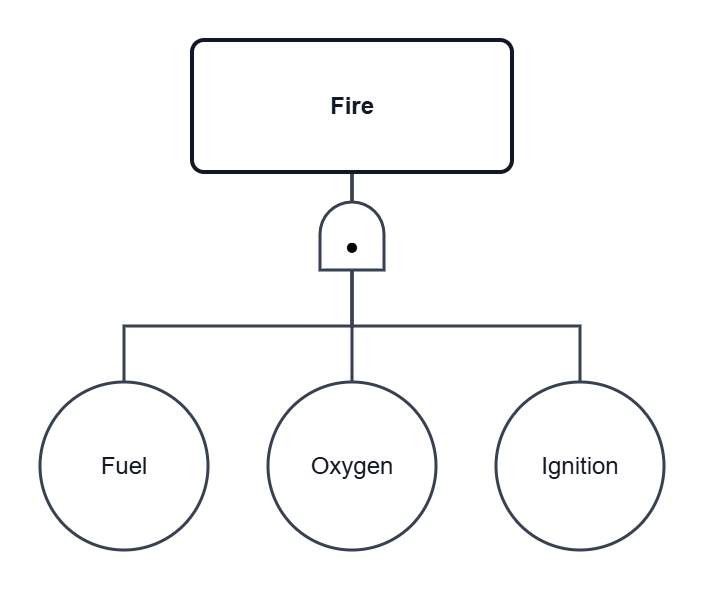
We need to logically deduce the direct causes leading to the fire[cite: 12]. Based on common sense, three conditions must exist simultaneously for a fire to occur: fuel, oxygen, and an ignition source[cite: 12]. None can be missing[cite: 12].
Since all three events (fuel, oxygen, ignition source) must occur simultaneously to trigger the top event, we use an AND gate[cite: 12]. Thus, directly below the "Fire" top event, we connect the three necessary intermediate events using an AND gate[cite: 12].
Step 3: Expand Branch Events Downward
Just like in Step 2, list the direct causes for each intermediate event and connect them using appropriate logic gates[cite: 12]. Let's break down the fuel, oxygen, and ignition source intermediate events one by one[cite: 12].
For the fuel branch, the fuel can be solid, liquid, or gas[cite: 12]. As long as one exists, the fuel condition is met[cite: 12]. Therefore, these three basic events pass through an OR gate[cite: 12].
For the ignition source branch, it could be caused by a spark, human misuse, or a flame[cite: 12]. Similarly, if any of these occur, an ignition source is generated, so they are connected using an OR gate[cite: 12].
Oxygen fully exists in the natural atmosphere without alternative combinations, so it exists directly as a basic event[cite: 12].
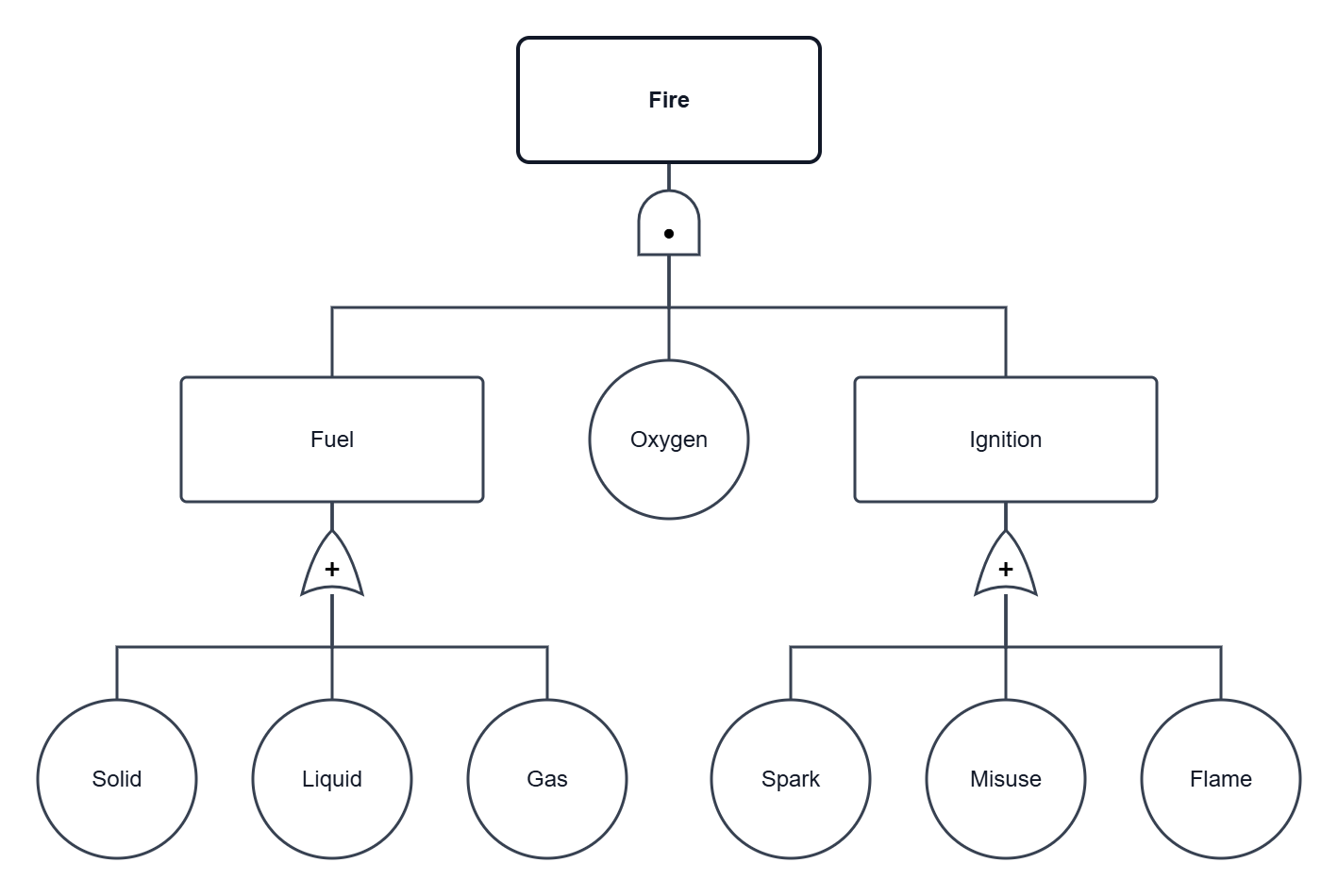
Note that building a fault tree is an iterative process, so contributing events must be continuously broken down into basic sub-events until they can no longer be decomposed[cite: 12]. We repeat this third step until decomposition is impossible[cite: 12]. This example stops here[cite: 12].
Step 4: Collect Failure Data
To quantify the risks associated with the undesired event, we need to collect failure data (from historical records, industry databases, expert opinions, etc.) for the fault tree's basic events[cite: 12]. Failure data should be expressed as failure probabilities or failure rates, depending on the type of analysis being performed[cite: 12].
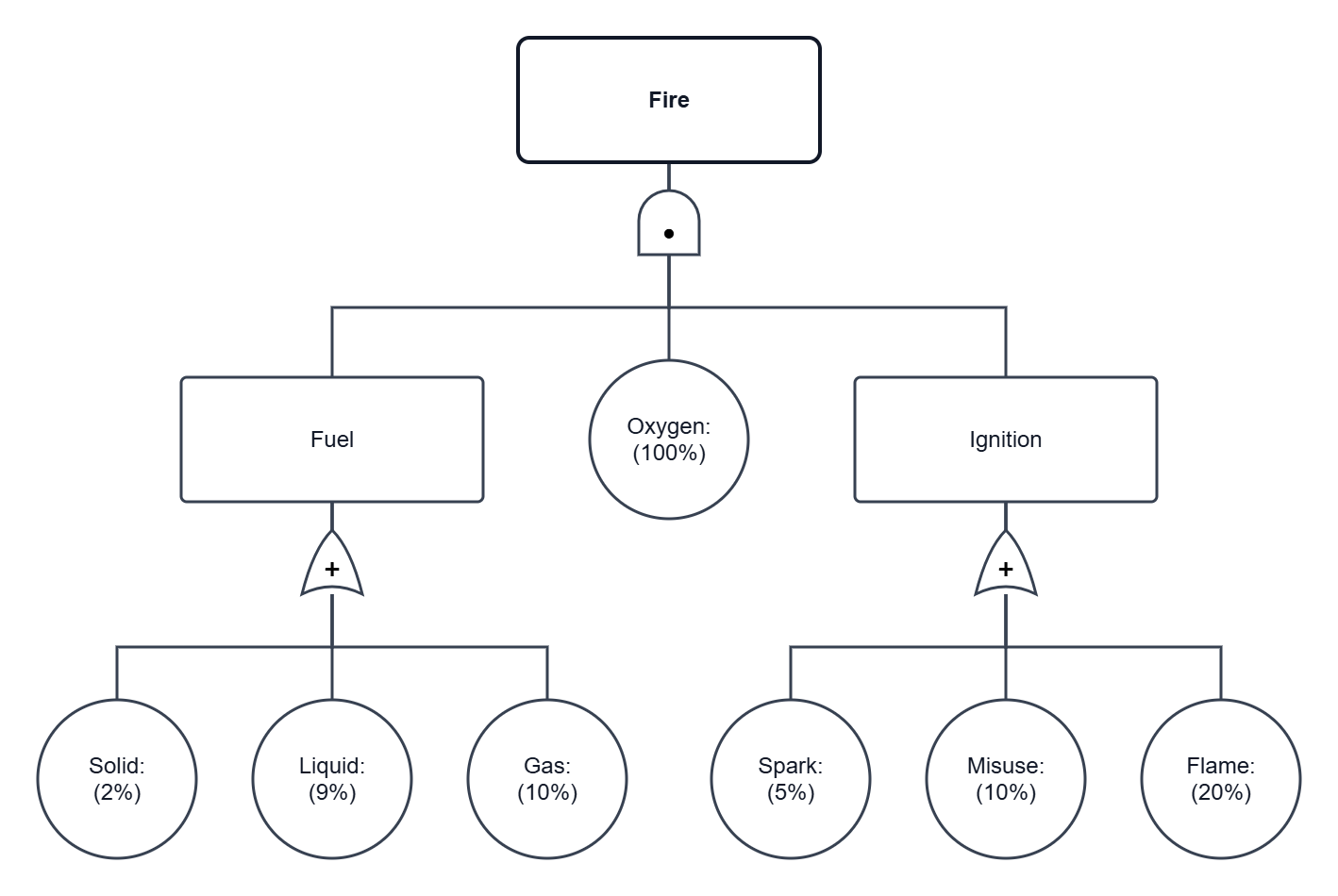
Suppose we collected the following probability data[cite: 12]:
- Gas fuel: 10% (0.1)[cite: 12]
- Solid fuel: 2% (0.02)[cite: 12]
- Liquid fuel: 9% (0.09)[cite: 12]
- Oxygen: 100% (1.0)[cite: 12]
- Spark: 5% (0.05)[cite: 12]
- Misuse: 10% (0.1)[cite: 12]
- Flame: 20% (0.2)[cite: 12]
Step 5: Perform Fault Tree Analysis and Calculate Probabilities
Calculations must follow the basic rules of fault trees (or probability theory)[cite: 12]:
- For OR gates: Add the probabilities of the input events[cite: 12].
- For AND gates: Multiply the probabilities of the input events[cite: 12].
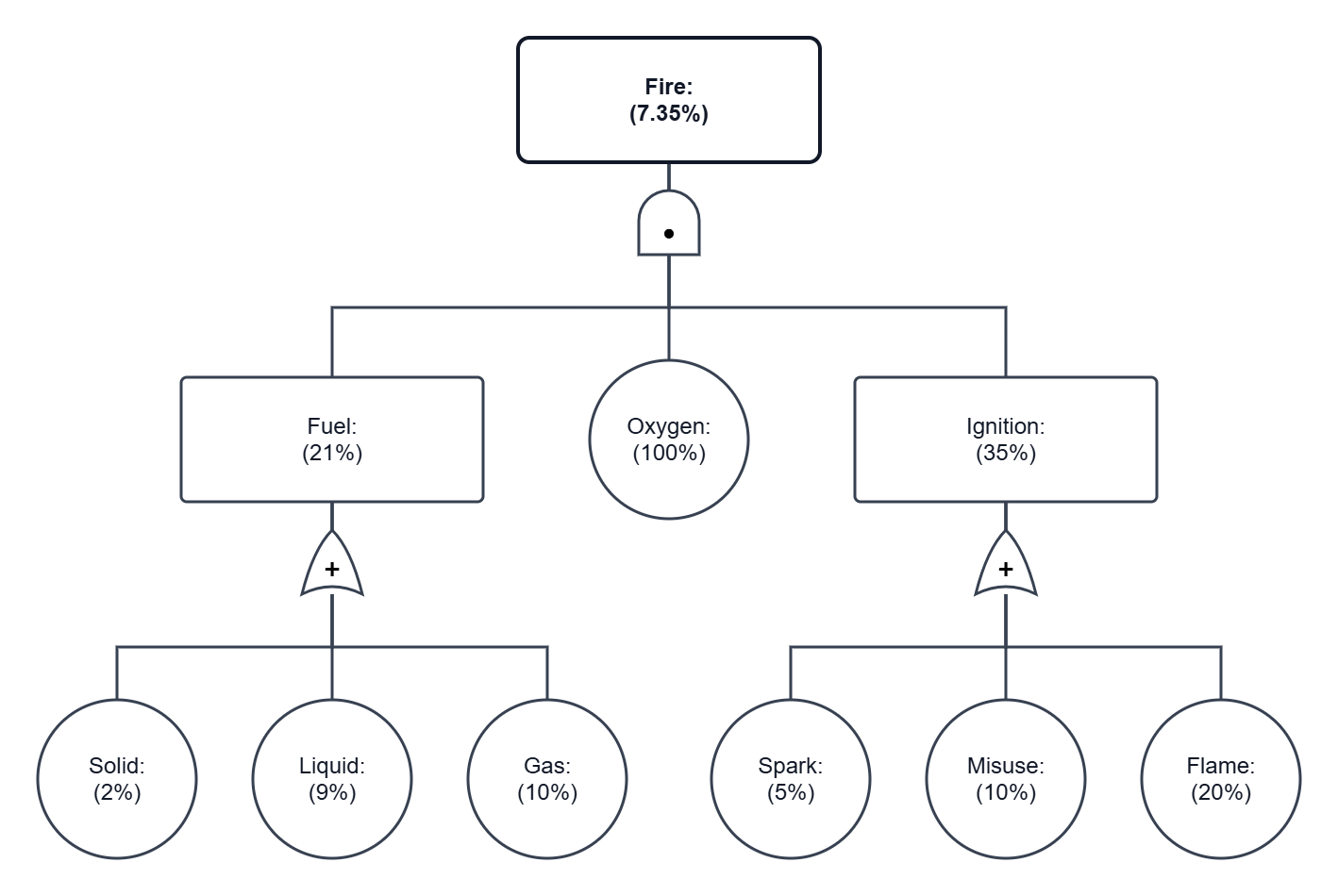
Performing a bottom-up calculation yields[cite: 12]:
Probability of Ignition Source = Spark + Misuse + Flame = 0.05 + 0.1 + 0.2 = 0.35 (35%)
Probability of Top Event (Fire) = Fuel × Oxygen × Ignition Source = 0.21 × 1.0 × 0.35 = 0.0735 (7.35%)
Step 6: Result Evaluation and Preventive Strategies
Based on the above calculations, the overall probability of a fire in this workplace is 7.35%[cite: 12]. How can we prevent this accident? We simply need to eliminate any single condition under the "AND gate" connected to the top event to break the fire chain[cite: 12].
Since oxygen exists naturally in the atmosphere, eliminating it is impractical; we can only choose between controlling "fuel" and the "ignition source"[cite: 12]. Because both are connected to OR gates below them, eliminating them requires blocking all their lower-level sources respectively[cite: 12]. For example, all solid, liquid, and gaseous fuels must be removed simultaneously, or sparks, flames, and misuse must be prevented simultaneously[cite: 12].
Further comparing the probabilities of intermediate events reveals that the probability of an ignition source (35%) is significantly higher than the presence of fuel (21%)[cite: 12]. This indicates that in this specific scenario, the risk tendency of an ignition source causing an accident is greater[cite: 12]. Therefore, as a core safety management strategy, engineers should prioritize focusing on controlling and preventing all ignition sources, thereby most effectively reducing the risk of an accident[cite: 12].
The fire case is from the video below[cite: 12]: